secret-redactor
Replaces secrets and personal identifiers with stable placeholders.
Illustrated demo by ClaudeMods · By Ray Amjad · Updated Oct 2, 2026
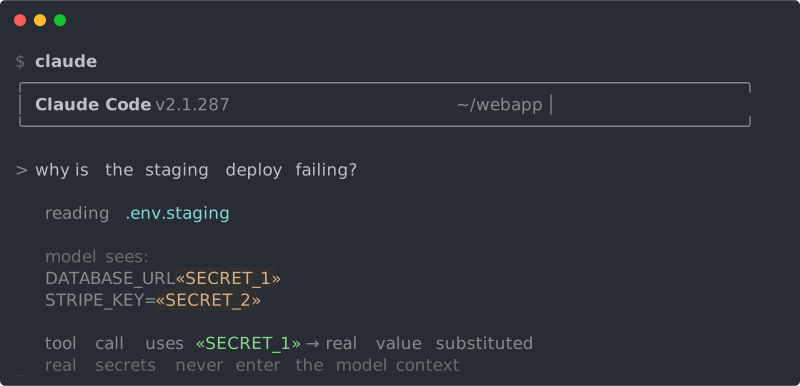
What secret-redactor looks like in use

Before you install
A mod is not sandboxed. It runs inside Claude Code with your permissions. This one:
- can read Prompts
- can read tool inputs and results
- can read and prompt attachments
Check it yourself before running it: git clone https://github.com/ray-amjad/claude-code-mods && claude plugin validate ./ · MIT licensed
Install
claude plugin marketplace add ray-amjad/awesome-claude-code-function-hooks
claude plugin install secret-redactor@awesome-claude-code-function-hooks
Needs Claude Code 2.1.287 or later. After installing, run
/reload-plugins if the session was already open.
Full install guide
What changes after installation
Supported secrets, email addresses and public IP addresses become stable placeholders before the model reads them. When Claude uses a placeholder in a tool call, the mod substitutes the real value so commands and writes can still work.
Private network addresses remain visible by default. Options can adjust secret detection, personal-data handling and allowlists.
Good to know
Detection combines known formats and entropy heuristics, so review its behavior with representative non-production data. The current marketplace redirect resolves to the author’s claude-code-mods repository; the documented marketplace identifier remains the one shown above. Verify the resolved source during installation.
Similar mods
blast-radius
Explains the likely impact of a risky shell command before it runs.
collision-guard
Warns when another open Claude chat recently edited the same file.
recording-mode
Masks screen text and blocks selected private files while recording.
budget-guard
Warns near a cost or plan limit and blocks work past it.
Popular mods
agent-profiler
Breaks a session into model wait, tool and subagent time.
Agent Time Machine
Records tool calls and project snapshots on a branching timeline.
context-inspector
Finds repeated reads, similar outputs and compaction-related waste.
loop-detective
Collects evidence when the same Bash failure keeps repeating.